

Europe’s Rainy Bias Returning; Crop Quality At Risk
By Andrew Owen
Kansas City, June 14 (World Weather Inc.) –Europe has struggled with frequent rainfall over the past few weeks and flooding occurred from time to time in various locations. Some improving weather occurred recently allowing the topsoil to firm up a bit and to reduce river and stream flooding that was occurring in parts of France earlier this season. However, weather patterns are  evolving back toward a wetter bias and rain will be falling frequently in the coming week from France, to Poland and southward to northern Italy. The rainy weather has already negatively impacted some of the region’s rapeseed and grain quality and more of the same will likely occur over the next week to ten days.
Rainfall was not as abundant in Europe this past week as it has been and some net drying evolved for a little while. However, rain did begin falling over the weekend from the United Kingdom and France to the Balkan Countries. Areas from France, southern Germany, and neighboring areas through the Balkans region reported 0.50 to 2.00 inches of rain with local amounts of 4.00 inches or more in northern Italy and the Czech Republic for the seven-day period ending this morning. The United Kingdom received 0.25 to 1.50 inches of rain with greater amounts while areas from northern Germany and Poland through the Baltic States received a trace to 0.50 inch of rain in most locations. Outside of one location in northern Spain reporting 1.00 inch of rain, the Iberian Peninsula was mostly dry.
Several areas in northern Italy, the Czech Republic, and southern Germany are still excessively wet in the topsoil due to continued rainfall. Other areas in Europe reported a minor amount of drying. A large portion of Western Europe would benefit from a reduction in rainfall in the coming weeks to further firm up the topsoil and to protect crop conditions. There is enough moisture in the subsoil to promote good crop growth conditions for an extended period of time.
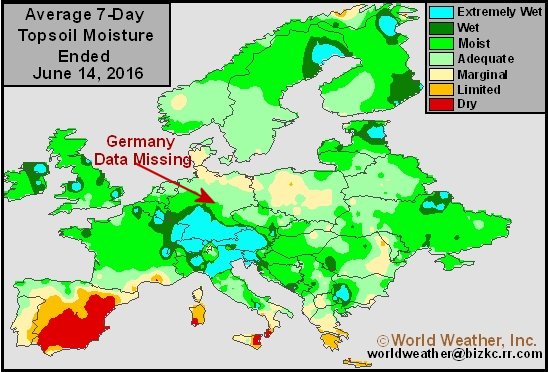 Winter rapeseed quality declines are already suspected because of the wet bias that occurred earlier this season and the potential for additional declines is running high because much of the crop is in the late filling, maturing and harvest stages of development. Rain will prolong harvest delays. Southern Germany, northern Italy, the Czech Republic, and immediate neighboring areas are already too wet and the additional rain this week will lead to flooding and a rising level of concern for rapeseed and developing winter grains. Most of the summer coarse grain and oilseed crops have been less impacted by the wetter bias, but there is a growing level of concern. Spring and summer crops will need some significant drying soon to stimulate the best possible crop development conditions.
Scattered shower activity will evolve on a frequent basis across Europe during the next seven days. The frequent precipitation will either keep soil moisture at current levels or bolster it. The wettest locations through next Tuesday morning will be in southern and eastern Germany, northern Italy, the Czech Republic, Slovakia, and immediate neighboring areas with moisture totals ranging from 2.50 to 7.00 inches with locally greater amounts. The remaining portions of Europe outside southern Spain, southern Italy, and portions of the Balkans region will receive 0.75 to 2.50 inches of rain with locally greater amounts. Rainfall elsewhere will be too light to counter evaporation in most locations.
Temperatures will trend cooler than normal in Western Europe and warmer than normal in Eastern Europe. Despite the frequent precipitation, Eastern Europe will not likely experience as many quality problems as Western Europe due to slightly better soil conditions to begin with. Winter wheat and rapeseed maturation and harvesting will advance slowly at times, although no major quality declines are expected. Rapeseed conditions will further deteriorate in Western Europe, most notably for the areas that receive the greatest amount of rain.
World Weather, Inc. forecasts and comments pertaining to present, past and future weather conditions included in this report constitute the corporation’s judgment as of the date of this report and are subject to change without notice. Comments regarding damage or the impact of weather on agricultural and energy as well as comments made regarding the impact of weather on the commodity and financial markets are the explicit opinions of World Weather, Inc. World Weather, Inc. can not be held responsible for decisions made by users of the Corporation’s information in any business, trade or investment decision.
©2016 World Weather, Inc. Any unauthorized redistribution, duplication or disclosure is prohibited by law and will result in prosecution.