

Rising Soil Temperatures Stir Wheat Development
By Andrew Owen
Kansas City, February 17 (World Weather Inc.) – Warm weather in recent days significantly increased soil temperatures in the central  and southern Plains. Winter wheat came out of dormancy early due to the warm weather in portions of Texas, Oklahoma, and parts of southern Kansas. Winter crops were also breaking dormancy and beginning significant growth in parts of the Delta and southeastern states. Additional warming during the coming week will bring more crops out of dormancy in the central Plains and portions of the Midwest. However, a colder airmass is expected at the end of February and beginning of March that will arrive in time to help limit the amount of growth that occurs and cause many crops to return to a dormant or semi-dormant state.
Current soil temperatures are warm enough to promote winter wheat growth in much of Texas, Oklahoma, and portions of southern Kansas. Some of the greening and early crop development 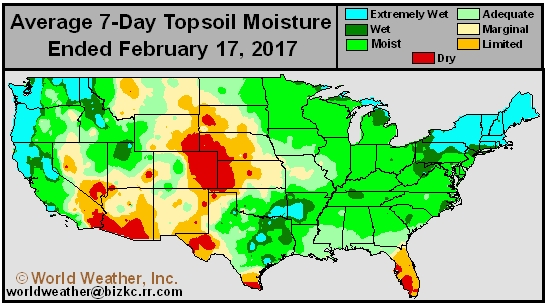 was stimulated just recently after significant rain fell early this week following record setting warmth that occurred a week ago. Areas further north in northern Kansas, Nebraska and eastern Colorado may be warm enough for a minor amount of growth, though most of the crops are still dormant or semi-dormant.
Winter wheat conditions in Oklahoma and eastern sections of the Texas Panhandle are in generally favorable shape. Timely precipitation earlier this month bolstered topsoil moisture to adequate levels in most areas. However, the high Plains region has short to very short soil moisture which has helped to limit new crop development.
Hard red winter wheat does not normally come out of 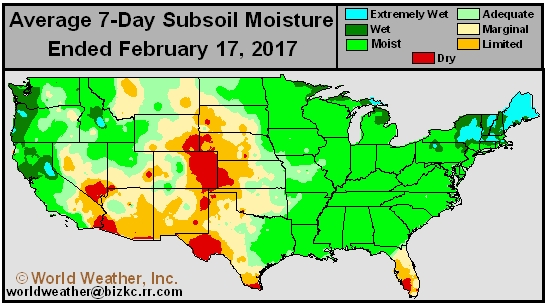 dormancy quite this early and when it does there can be some risk to crops when bitter cold weather evolves prior to the normal start of spring. Crop development needs to be kept in check over the next few weeks until the normal last freeze date passes to minimize the risk of permanent crop damage in the event a significantly cold airmass comes along after growth has occurred for a while. Temperatures will continue to trend warmer than normal through the end of next week. Daytime highs will peak into the 60s and lower 70s Fahrenheit across the central Plains, the Ohio River Valley, Delta and southeastern states through Wednesday. Colder air will begin to lower temperatures at the end of next week, though temperatures will remain several degrees above average for this time of year.
Winter wheat growth will continue across the southern Plains and in portions of the central Plains during the coming week. Central Oklahoma will see brief periods of light rain while the remaining production areas trend dry or mostly dry. The lack of rain, warm weather and short soil moisture will not be the best environment for the winter wheat development which could be a blessing in keeping crop growth in check. Many crops in the central Plains and lower Midwest that break dormancy or have broken dormancy will be pushed back into a semi-dormant state in early March due to the colder weather that is expected. Crops further south, however, will continue developing and that is the area that will need to be most closely monitored for a more threatening freeze later this season.
Significant precipitation will be needed in the high Plains region during March to assure the best possible crop development later in the spring. Portions of the central Plains are still considered to be in a drought and recent weeks of precipitation has not been sufficient to support crops very well. World Weather, Inc. expects more rain in the central and southern Plains during March that should further improve soil moisture. There is some concern for northwestern wheat areas where significant moisture may be a little harder to come by for a while.
In the meantime, winter crops in the Delta and southeastern states have adequate soil moisture for crop development this early spring. No frost or freeze conditions are expected for a while and brief periods of light precipitation in the next couple of weeks will be good support for ongoing crop development. Colder weather in late February and early March will slow or possibly even set back crop growth for a little while, but the environment should remain favorable for production going as the warmer days of spring approach.
Portions of the Midwest’s soft winter wheat production region will warm enough in the coming days to bring crops out of dormancy. However, no extended period of growth is expected for the region.
World Weather, Inc. forecasts and comments pertaining to present, past and future weather conditions included in this report constitute the corporation’s judgment as of the date of this report and are subject to change without notice. Comments regarding damage or the impact of weather on agricultural and energy as well as comments made regarding the impact of weather on the commodity and financial markets are the explicit opinions of World Weather, Inc. World Weather, Inc. can not be held responsible for decisions made by users of the Corporation’s information in any business, trade or investment decision.
©2017 World Weather, Inc. Any unauthorized redistribution, duplication or disclosure is prohibited by law and will result in prosecution.