

Warm, Dry Weather In France Harming Crops
By Andrew Owen and Drew Lerner
Kansas City, July 6 (World Weather Inc.) – Significant drying occurred across much of the European continent during the past week, but no area has suffered more from the lack of precipitation and hot temperatures than France. Most unirrigated crops in France are dealing with a high level of stress that is likely pushing summer crop production potentials lower. Net drying occurred in many other areas, but favorable subsoil moisture was helping to minimize some of the impact. With that said, dryness is stressing crops in Hungary and immediate neighboring areas, as well as eastern Romania into some central Ukraine and Belarus locations. France will see little to no rain over the next week to ten days while some other areas in Europe get a little rainfall. Southeastern parts of the continent will continue to dry out. The best news is that most of the excessive heat of recent days is abating and temperatures should become more seasonable in northern areas later this week.
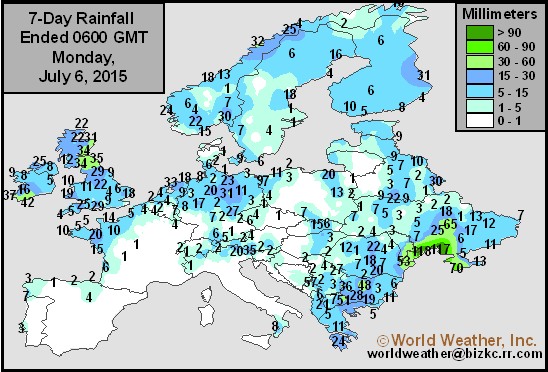 Rainfall in Europe during the past week was mostly below average. Several areas from Greece through central and eastern Ukraine reported 0.25 to 1.00 inch of rain for the seven-day period ending this morning. Local rain amounts ranged from 2.00 to 4.65 inches in southern Ukraine while portions of Bulgaria reported up to 2.00 inches. The United Kingdom, western fringes of France, and northern Germany received 0.20 to 1.00 inch of rain with locally greater amounts. The remaining production areas in Europe received little or no rain and experienced a notable loss in soil moisture because of warm to hot temperatures.
The warm weather and lack of rain in a large portion of Europe led to net drying during the past week. Topsoil moisture was rated very short from Spain and Portugal through France to western and southern Germany. Several other areas from northern Serbia and northwestern Romania through Hungary to parts of Czech Republic were also very short of topsoil moisture. Most other areas had marginally adequate to short topsoil moisture and were not suspected of being as stressed.
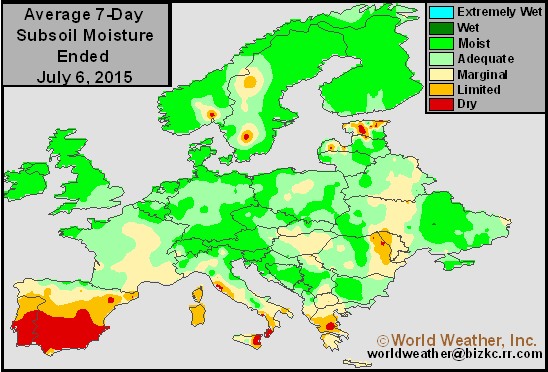
Subsoil moisture was rated short in central and interior eastern France, as well as in much of Hungary and immediate neighboring areas, as well as eastern Romania into Moldova and parts of central Ukraine and southeastern Belarus. These drier biased subsoil soil areas represent the regions in Europe that may be suffering from the greatest stress. Production potentials are most at risk in these drier biased areas.
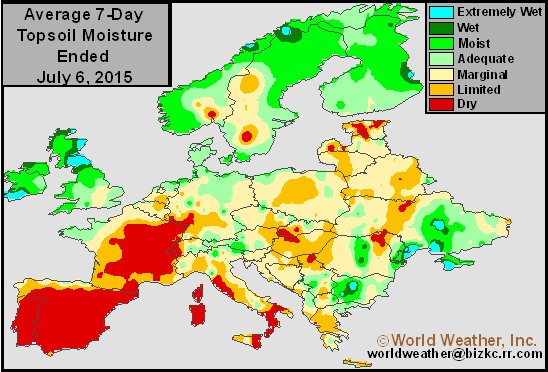
Rain is needed to avoid an expansion of the most serious crop stress in France. There is not enough moisture in the ground to promote good development conditions and until significant rain falls crops in the region will continue to suffer and may lose some production potential over time.
Most of the excessive heat of recent past days will abate and that will reduce some of the pressure on crops with low soil moisture. Temperatures will continue near to slightly warmer than usual for a while with near to slightly warmer than usual conditions expected from northern France to Poland while a more significant bias for warmer than usual weather prevails in southern parts of the continent. Scandinavia will be the only cooler biased region. High temperatures will eventually vary from the upper 60s and 70s across northern parts of Europe while 70s and 80s continue in the south.
France will spend a large part of the next two weeks without significant precipitation. Any showers that occur will be brief and light failing to lift soil moisture or change crop conditions. Northern and western areas will get a few showers, but resulting rainfall will not be more than 0.30 inch with many amounts much lighter. Soil moisture reductions will continue and a much larger portion of the country will have a serious moisture deficit by the beginning of next week. Crop stress will continue to rise slowing plant development rates and pressuring yield potentials in unirrigated corn, sorghum, sunseed, sugarbeets and soybean areas. Winter wheat and rapeseed will be least impacted since most of those crops have completed reproduction and are now maturing and being harvested. The dry and warm weather is expediting winter crop maturation and harvest progress and this process will continue over the next two weeks.
Areas from Germany through Ukraine and the Balkan Countries will see brief periods of light rain during the coming week. Rain amounts will be too light to counter evaporation in most instances and temperatures will often trend near to above average. Net drying will continue and could begin to slow crop development rates and allow a little crop stress to evolve, as well. Crop stress will be most serious in Hungary, and immediate neighboring areas due to the limited topsoil moisture situation and expanding dryness in the subsoil.
In contrast, the Baltic States will see timely rain and warm weather this week. Crop development will advance under mostly favorable conditions, though a few pockets of dryness may remain by the beginning of next week.