

Rain To Help Bolster Canada Prairies Soil Moisture
By Andrew Owen
Kansas City, September 3 (World Weather Inc.) – Two low pressure centers and a frontal passage will promote timely precipitation in portions of the Prairies this weekend and the beginning of next week. While the rain will be ill-timed for farmers trying to get into the fields to begin or continue the harvest, the rain will be needed to bolster soil moisture for use in the spring. The Prairies are expected to trend drier and warmer than normal over the winter season due to El Nino and replenishing the soil with moisture this autumn before the ground freezes up is important to assure the best possible start to the spring growing season. Several areas in the Prairies are still dealing with moisture shortages stemming from an extended period of dryness from the beginning of April through the middle part of July this year.
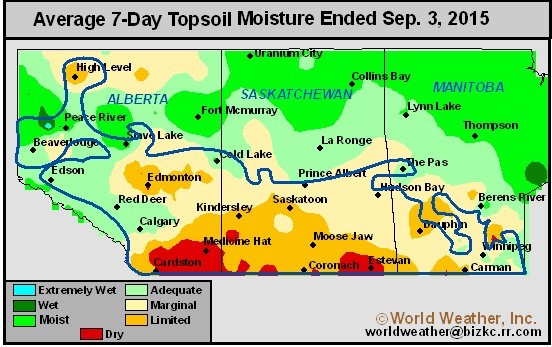
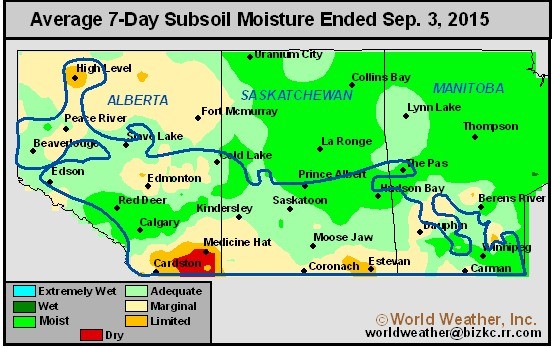
The most recent soil assessment suggests a large portion of the Prairies have short or very short topsoil moisture. The only exception is in portions of western Alberta where recent rain has the Peace River Region running mostly moist along with the front range region of the Alberta Rocky Mountains where soil conditions were mostly rated adequately moist. Subsoil moisture was still quite limited in southern Alberta and running marginally adequate to short in southern Saskatchewan and across portions of central, northern and western Alberta. A few areas in Manitoba are also reporting short to very short topsoil moisture and short to marginally adequate subsoil moisture.
The crop areas running shortest on top and subsoil moisture are the ones in greatest need for rain this autumn before the ground freezes up for the season. The moisture replenishment is not absolutely necessary, but it would reduce concern over dryness in the spring when the ground finally thaws out. The long winters and deep frost that gets into the ground in Canada makes it important that the region’s short growing season is primed with soil moisture to allow spring fieldwork to occur readily as soon as warming takes place. Dry starts to spring can delay planting while farmers wait for soil moisture and warmer soil temperatures.
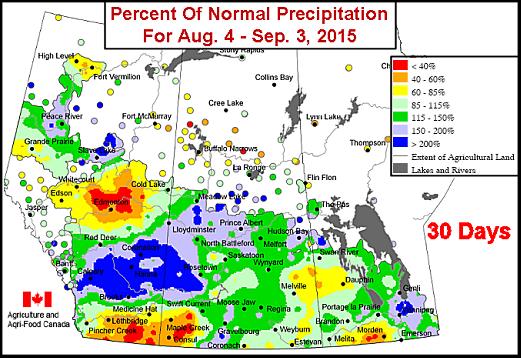
Rainfall varied across the Prairies August 4-September 2 with above average amounts from interior southern and east-central Alberta to northern crop areas in Saskatchewan. Rainfall was also near to above average in south-central into central Saskatchewan and in easternmost parts of Manitoba. The Peace River region was mostly wetter than usual during August, although High River and Fort Vermillion were notably drier than usual. The driest areas in the Prairies over the past month occurred in three areas with the first being from Edson through Edmonton to Cold Lake and extended north and south of that line by nearly 200 kilometers. Another notably drier biased region in August was south of Highway One from east of Pincher Creek through Medicine Hat to southwest of Swift Current. The last area of dryness in the last 30 days was in far southern Manitoba from near Morden west to near Melita. One more area that was not quite as dry as the other areas occurred from the Melville/Yorkton areas of Saskatchewan into the Dauphin Swan River areas of Manitoba. Most of these drier biased areas received 40-80% of normal rainfall with a few areas getting less than 40%.
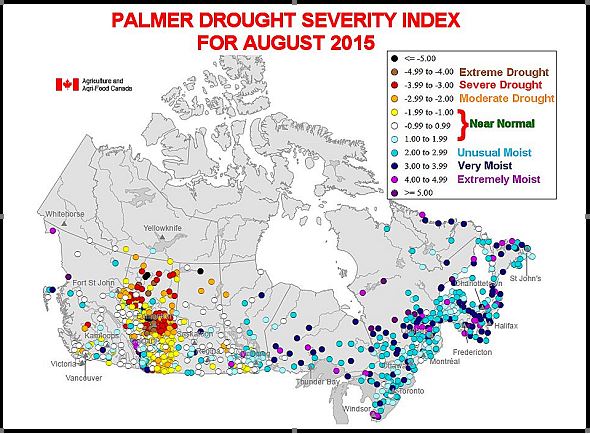
As of the end of August no area was running greater moisture deficits than northeastern crop areas of Alberta where the Palmer Drought Index was rating the area in a severe drought.
Before timely rain evolved in portions of the Prairies in August, almost the entire region was suffering from drier than normal conditions and those conditions prevailed from April 1 through mid-July. The Prairies came into spring without much snowpack (as is expected in spring 2016), but the soil was fully charged with moisture after abundant rain in the previous autumn. Planting began earlier than normal and establishment got off to a good start.
The quick start to planting was followed by some notable frost and freeze events that damaged the earliest planted crop and caused many producers to reseed. The early spring dry bias then festered from early April to July 20 allowing soil moisture to become depleted over time and that created crop stress in June and July. Crop development conditions gradually deteriorated over the first half of summer as the dryness prevailed and expanded.
Rain developed in late July and then occurred a little more routinely the remainder of the summer. Rain in August promoted a better environment for several crops. Improved soil conditions helped many crops finish development under more favorable conditions compared to earlier in the summer. The driest areas in southern Alberta, southwestern Saskatchewan, and northern and north-central Alberta continued to see poor crop development with the remainder of the prairies experienced improving conditions.
Most of today’s moisture deficits are a byproduct of the summer dryness scenario mentioned above. Rain is needed in the next few weeks to restore soil moisture to more adequate levels before winter. The El Nino phenomenon will promote a drier and warmer than normal winter season in a large across most of the Prairies.
The lack of snow over the winter will be a concern for many producers. Snow melt in the spring is important for restoring soil moisture. If there is less snow than normal while the soil is already drier than normal, then the moisture deficits could impact planting progress next spring. Although rainfall in the coming weeks will disrupt maturation and harvesting, precipitation is needed to restore soil moisture before the ground becomes too cold to absorb moisture.
A strong low pressure center from the northern U.S. Plains and a frontal passage will generate strong showers and thunderstorms in Saskatchewan and Manitoba Sunday and Monday. Rain amounts will range from 0.50 to 1.50 inches with several areas in Saskatchewan that will receive more than 2.00 inches of rain. Alberta will trend mostly dry both days. The rain will be enough to restore soil moisture to more adequate levels, although additional rain will still be needed to fully restore soil moisture.
Light and erratic rain will occur through Saturday before the main rain event occurs Sunday and Monday. The rain will slightly bolster soil moisture in portions of Alberta and Manitoba. However, moisture deficits will continue in most areas. There will be little follow up rain during the middle and latter part of next week. However, the periodic precipitation pattern that has occurred in recent weeks will continue through the second part of September. The periodic rainfall will slowly help to improve soil conditions in many areas, but time will be running short. October weather will likely start trending drier and warmer than usual and it may prevail for a while.
Portions of Alberta and western Saskatchewan may still be dealing with significant moisture shortages by the end of September.
World Weather, Inc. forecasts and comments pertaining to present, past and future weather conditions included in this report constitute the corporation’s judgment as of the date of this report and are subject to change without notice. Comments regarding damage or the impact of weather on agricultural and energy as well as comments made regarding the impact of weather on the commodity and financial markets are the explicit opinions of World Weather, Inc. World Weather, Inc. can not be held responsible for decisions made by users of the Corporation’s information in any business, trade or investment decision.
©2015 World Weather, Inc. Any unauthorized redistribution, duplication or disclosure is prohibited by law and will result in prosecution.