

South America Spring/Summer Outlook Favorable For Most
By Drew Lerner
Kansas City, September 4 (World Weather Inc.) – Weather conditions coming into the planting season for Brazil, Argentina, Paraguay and Uruguay are looking mostly good, but there are some ongoing issues with dryness in western Argentina. Weather patterns recently deviated from traditional El Nino influences long enough to remove the incredibly wet bias that evolved in June and July in southern Brazil, but the wetter bias is about to make a big come back. The wet bias in southern Brazil will become a festering pattern during the spring planting season and it may not be until sometime in late December or early January that the region dries out again. Some Moisture deficits are anticipated in Mato Grosso and Goias this late spring and summer, but below average rainfall is not always a problem since the region usually gets more rain than it needs.
August produced some notably different weather in South America relative to that which often occurs in El Nino years. The exceptionally wet weather that usually impacts southern Brazil was shifted to the southwest and influenced Argentina, Uruguay and southern portions of Rio Grande do Sul during the month.
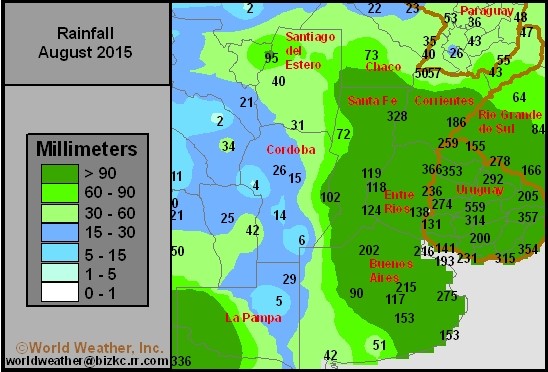
Eastern Argentina received well above average precipitation in August. Rain amounts for the month ranged from 3.00 to 8.50 inches with local amounts up to 12.90 inches from central and eastern Buenos Aires through Santa Fe and central Corrientes. Flooding damaged some of the wheat plantings in these wetter areas, but improved weather in recent weeks has restored favorable soil moisture.
Santiago del Estero, Chaco, Formosa, northern Corrientes, eastern Cordoba, and western Buenos Aires received 1.00 to 3.00 inches of rain with locally greater amounts. La Pampa, San Luis, and the remaining portions of Cordoba received 0.25 to 1.00 inch of rain with locally greater amounts. The rain in eastern Argentina was well above average for the month of August with most of it occurring in the first half of the month. Argentina normally receives restricted amounts of rain during the winter.
Topsoil moisture in eastern Argentina decreased during the past two weeks due to little rain and periods of warmer than normal weather. There is still plenty of moisture in the subsoil. Timely rain will be welcome in the coming weeks to promote aggressive planting and establishment in the east. The main concern for Argentina is the lack of moisture in the west. Soil moisture is short or very short. Significant rain will be needed before aggressive planting will begin.
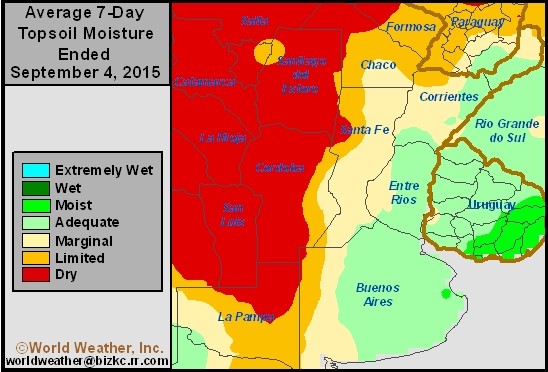
Argentina rainfall in the next two weeks will not likely offer enough precipitation to seriously change the moisture deficits that remain in western parts of the nation. Some rain may impact portions of the nation, but much of the precipitation is expected to be lighter biased.
In the meantime, changes in Brazil weather are beginning. The influence of El Nino in the spring typically produces frequent rain in southern Brazil. The region often becomes a little too wet during the planting season causing delays to fieldwork. This year is expected to be no different, although initial conditions in early September are better than usual.
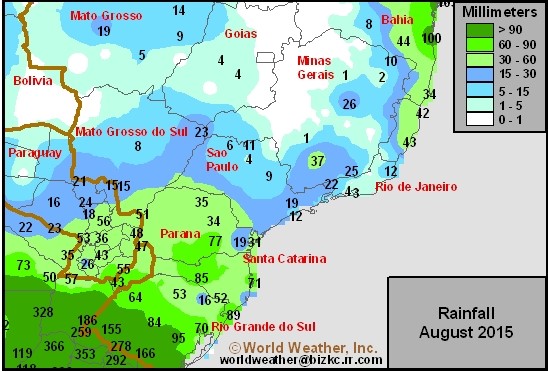
Rainfall varied in Brazil during the month of August. Areas from Parana and southern Mato Grosso do Sul south through Rio Grande do Sul reported 1.35 to 3.75 inches of rain with several areas in southern Rio Grande do Sul receiving 6.50 to 11.00 inches of rain. Central Mato Grosso do Sul, Sao Paulo, and southern Minas Gerais received light rain while Espirito Santo and eastern Bahia received 1.30 to 4.00 inches of rain.
Portions of southern Brazil have adequate soil moisture. Most other areas have short or very short soil moisture, which is normal for this time of year. Timely rainfall normally increases in September and continues through the end of the year.
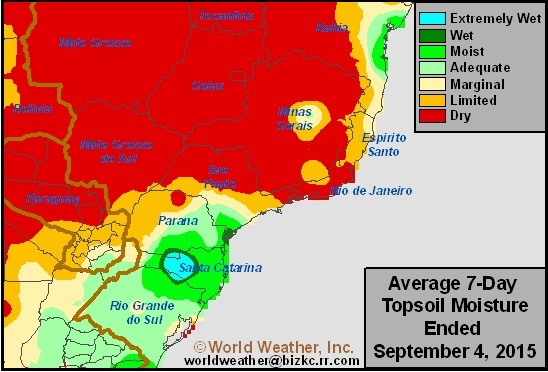
Southern and portions of center-south Brazil are expected to see periods of wetter than normal conditions stemming from El Nino in the coming weeks. The biggest near term concern over increasing wet weather that will evolve in the next couple of weeks will be over the quality of winter wheat. Wheat harvesting is already under way in Sao Paulo and Parana and coming rainfall will slow the process down and possibly induce some grain quality concerns. Those concerns may expand southward over time as rainy weather impacts most areas from southern Minas Gerais into Mato Grosso do Sul, Paraguay and Rio Grande do Sul.
SEPTEMBER THROUGH NOVEMBER 2015
As noted above, the next few months (September through November) will be wetter biased in southern Brazil. The wetter biased conditions should include parts of Paraguay, Uruguay and eastern Argentina. Flooding may evolve in parts of this region from time to time and the concern over wheat harvest delays and grain quality are expected to prevail over the next few weeks. Quite often, El Nino events will ruin the quality of wheat in southern Brazil and there is potential for that to happen again this year.
The rainy weather over the next three months will also delay some of the spring planting that usually occurs. Usually the Brazilians are amazingly good at planting in and around the rain and even though the pattern will be wetter biased through the planting season fieldwork is expected to advance.
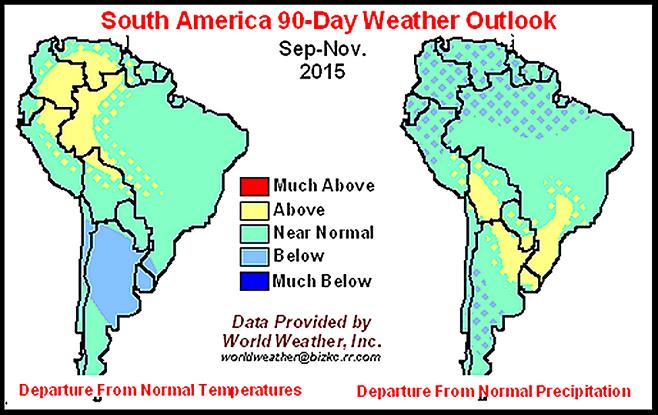
Eastern Argentina rainfall will be greater than usual through November, but western parts of the nation tend to get less than usual rainfall at times. Usually the driest bias shifts into the southwest part of the nation, but there have been some El Nino years that get critically dry. This year will be closely monitored because conditions are already quite dry in the west and rainfall during the coming month will not be hugely improved.
Argentina temperatures will be cooler than usual during the next three months (September through November). Some weeks will be more significantly cool than others. Crops should get planted favorably, but the cool conditions may keep growth rates a little sluggish initially. The cool conditions will conserve soil moisture and that may help the drier than usual bias in the west from festering into a more serious drought since the temperatures should not be hot.
Even though summer coarse grain and oilseed crops in Brazil will be subjected to planting delays and wheat quality issues are possible, other crops will find favor in the wetter bias. Sugarcane, citrus and coffee are all expected to get off to good starts this season because of the wetter bias. Coffee flowering will occur early and will be supported with good follow up rain to assure successful pollination and cherry setting. Citrus trees in Brazil should also benefit from the wetter trend this spring with flowering occurring aggressively a little earlier than usual. Sugarcane might benefit from the wetter bias for a little while, but if conditions get too wet the crop might suffer some from excessive moisture and limited sunshine for a while.
Northern crop areas in Brazil should be left out of the wettest bias and seasonal rains do not usually begin in those areas until late October. The seasonal rains should evolve normally with some areas from Minas Gerais and Espirito Santo to Mato Grosso possibly getting started with seasonal rainfall a little quicker than usual. Northern Minas Gerais, northern Espirito Santo and Bahia may experience some delay in the onset of seasonal rainfall, but conditions should improve quickly once the seasonal rains evolve.
DECEMBER THROUGH FEBRUARY 2016
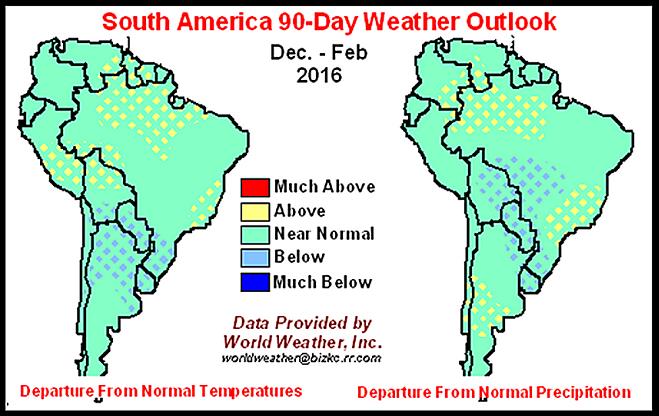
December through February is expected to be a time of transition. Rainy weather in southern Brazil will likely shift or expand northward. Quite often there is a short term break from rainfall in far southern Brazil, Uruguay and Paraguay during late December into January and this year is not expected to be any different. There will be some support for January and February lighter than usual rain in Mato Grosso, parts of Goias and eastern Bolivia. The drier bias should not be a seriously threatening event since the region tends to receive more rain than it needs in some summers. However, the situation will be closely monitored for signs of more aggressive drying than World Weather, Inc. anticipates. Most likely rainfall will be lighter than usual, but not limited enough to cause a production issue for grain, oilseeds, sugarcane or other crops.
Argentina weather will trend a little wetter in the west and south during the December through February period, but in particular during the same period in which southern Brazil shifts from a wet bias to a drier one in late December and early January. During those transitional weeks in late December and early January Argentina will trend wetter in the southwest and central parts of the nation while the northeast trends a little drier biased.
Temperatures during the summer this year are expected to be near and slightly above average in Brazil excepting the far south where readings may be a little cooler than usual. Northern and eastern Argentina may be a little cooler than usual, as well along with Paraguay
MARCH THROUGH MAY 2016
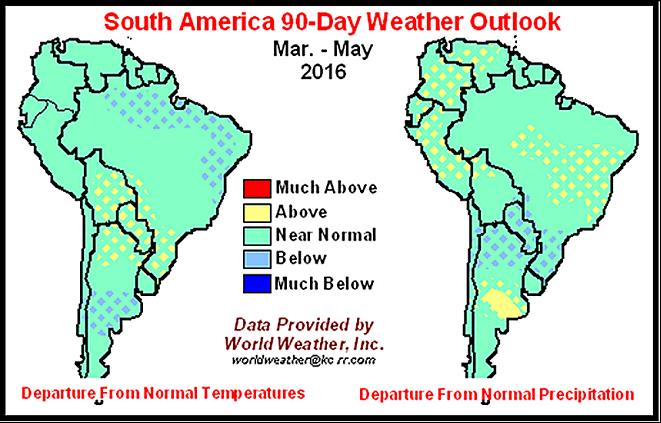
Autumn weather in South America is expected to be a little wetter than usual in parts of northern and eastern Brazil possibly slowing the harvest season for a little while. Wet weather may also impact southern Argentina while drier than usual conditions impact far southern Brazil, Paraguay and northern Argentina. Autumn 2016 will also be cooler biased in far southern Argentina and extreme northeastern Brazil while a little warmer than usual from southern Brazil to Bolivia and northern Argentina.
THE BOTTOM LINE
Overall, the production year 2015-16 promises to be successful in both Brazil and Argentina. There will be some potential for crop moisture stress during the summer in far southern Brazil, Paraguay, eastern Bolivia and far western Mato Grosso do Sul. Some wheat quality issues are likely in southern Brazil this spring and some crop moisture stress may evolve in far southern and southwestern Brazil and Paraguay for a little while in the early summer. Rice planting may be slowed by rain for short periods of time in southern Brazil. Most other grain, oilseed, cotton, rice, sugarcane, coffee and citrus production should be favorable. There will be some continuing concern over ongoing water supply shortages in Bahia, northern Minas Gerais and northern Espirito Santo – mainly because of normal rainfall on top of water reservoir levels that are still notably below average following multiple years of dryness.
World Weather, Inc. forecasts and comments pertaining to present, past and future weather conditions included in this report constitute the corporation’s judgment as of the date of this report and are subject to change without notice. Comments regarding damage or the impact of weather on agricultural and energy as well as comments made regarding the impact of weather on the commodity and financial markets are the explicit opinions of World Weather, Inc. World Weather, Inc. cannot be held responsible for decisions made by users of the Corporation’s information in any business, trade or investment decision.
©2015 World Weather, Inc. Any unauthorized redistribution, duplication or disclosure is prohibited by law and will result in prosecution.