

Rain Improves Wheat Planting West Ukraine To SW Russia
By Andrew Owen and Drew Lerner
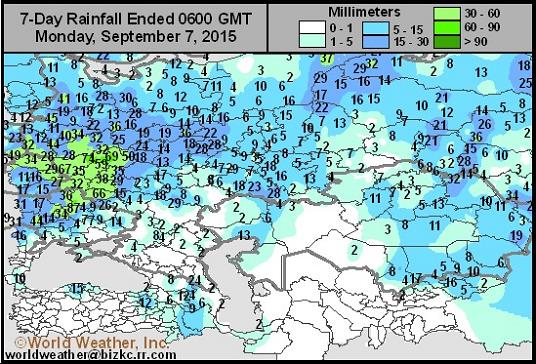
Kansas City, September 9 (World Weather Inc.) – Western Russia and neighboring areas in Belarus and northern Ukraine received significant precipitation during the past week. The rain was enough to bolster soil moisture and likely slowed fieldwork, but the moisture was needed to improve wheat and rye planting, emergence and establishment. Drier weather will be quick to return over the next two weeks and both the planting of 2016 crops and harvesting of the 2015 crop will advance swiftly. In the meantime, some much needed drying occurred in the eastern Russia New Lands while it remained a little too wet in northwestern Russia. Dryness remained a big concern for winter crop planting from southeastern Ukraine into the lower Volga River Basin.
Belarus, northern and western Ukraine, western Russia, and northern sections of the Volga River Basin all received precipitation recently. Rain totals for the seven-day period ending September 7 ranged from 0.50 to 2.60 inches with local amounts up to 3.45 inches. While these areas received precipitation, locations from eastern Ukraine through the lower Volga River Basin and the USDA defined “Southern Region” into western Kazakhstan received little or no rain. Rain that did fall in the driest areas was mostly too light to counter evaporation. The remaining portions of the western CIS received a trace to 0.75 inch of moisture with locally greater amounts.
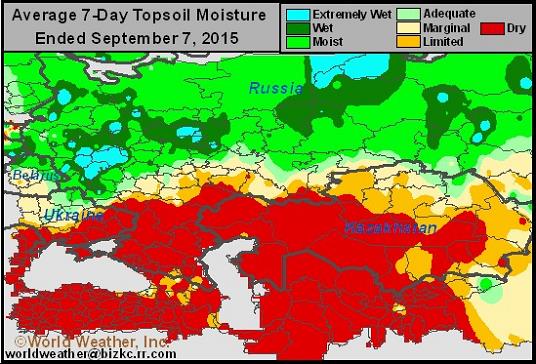
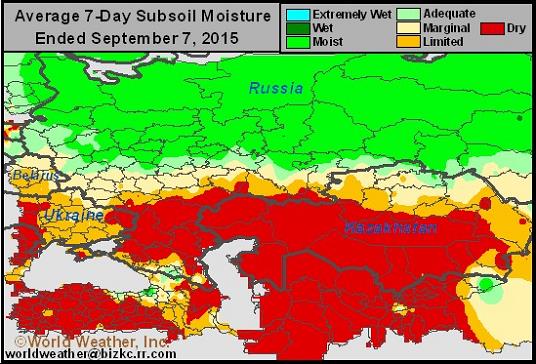
Topsoil moisture is adequate in much of the western CIS from northern and eastern Belarus and north-central Ukraine through the Eastern New Lands. There are many areas in western and northern Russia that are excessively wet in the topsoil due to the recent precipitation, but any flooding has likely been quite localized. The wetter areas are too wet for fieldwork and drying is needed to get both planting and harvesting back on track. Soil moisture remains short or very short from eastern Ukraine through western Kazakhstan.
Spring wheat, barley, corn, sunseed, and other spring and summer crop harvesting was likely slowed at times in western Russia and neighboring areas during the past week because of rain. Most crops have already matured or are maturing and do not have much need for moisture. Minor quality reductions to unharvested spring cereals and sunseed was concerned possible for the wettest areas of Belarus, northern Ukraine, and neighboring areas of Russia where the greatest amount of rain was reported. Other sections of the CIS saw mostly favorable maturation and harvest conditions during the past week.
Winter wheat and rye planting is well under way and it will continue into the early part of October. Fieldwork should be done or nearly done in the north where frost and freezes become more common over the next few weeks. Fieldwork should become more aggressive in Ukraine and southern Russia during the balance of September and early October making rain events such as that of this past week in the drier areas of the southwest all the more important. Planting and establishment conditions have been mostly favorable from the Baltic States through the Ural Mountains region, although a little too much rain since late August may have left a few fields a little too wet and poorly established.
Rain is still needed to significantly improve planting and establishment from eastern Ukraine through western Kazakhstan. Many crops may not be planted or may not establish well due to the lack of moisture. However, any increase in rainfall that occurs in the next few weeks would bring on tremendous improvements for planting and establishment.
An erratic, light, rainfall pattern will evolve over the next few days and linger through September 23. Much of the key crop production region from West Siberia to eastern Europe will experience net drying conditions. The environment will be almost perfect for the maturation and harvest of spring and summer crops while supporting the planting of 2016 wheat, rye and rapeseed. Greater rain will be needed soon in the drier areas from southeastern Ukraine into Kazakhstan and crops in that region may not be planted until significant rain falls and/or crop emergence and establishment will be poor until the environment moistens up.
World Weather, Inc. forecasts and comments pertaining to present, past and future weather conditions included in this report constitute the corporation’s judgment as of the date of this report and are subject to change without notice. Comments regarding damage or the impact of weather on agricultural and energy as well as comments made regarding the impact of weather on the commodity and financial markets are the explicit opinions of World Weather, Inc. World Weather, Inc. can not be held responsible for decisions made by users of the Corporation’s information in any business, trade or investment decision.
©2015 World Weather, Inc. Any unauthorized redistribution, duplication or disclosure is prohibited by law and will result in prosecution.