

Ghana, Ivory Coast In Need Of Better Rainfall
By Andrew Owen and Drew Lerner
Kansas City, September 10 (World Weather Inc.) – Portions of Ghana, western Nigeria and Ivory Coast have been drier than normal for many weeks. Timely rain was reported earlier this spring and early summer when the Intertropical Convergence Zone (ITCZ) advanced across the region. However, rain totals were below average and the ITZC shifted to the north of the driest region during late July and August, causing drier conditions to evolve in areas that had poor subsoil moisture threatening coffee, cocoa, sugarcane and rice production. Seasonal rain normally comes back in September and October, but so far it has not rained much and that has contributed to ongoing crop stress and raising concern over production potentials. The ITCZ usually moves back to the south into crop areas over the next few weeks, but El Nino is likely to restrict rain amounts and that could further stress coffee, cocoa, rice, sugarcane and other crops in the region.
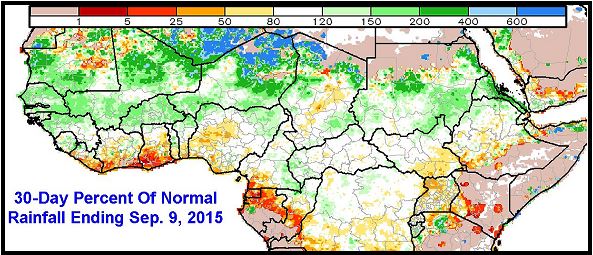
A broad region of below average rainfall has occurred recently from western and some central Nigeria locations through southern Benin and southern Togo to central and southern Ghana and many areas in Ivory Coast to Liberia. Much of the described region received 50-80% of normal rainfall, but there were quite a few areas reporting 25 to 50% of normal rain and a few more in southern Ghana and southwestern Ivory Coast and Liberia reporting less than 25% of normal rain for the 30-day period ending September 9, 2015.
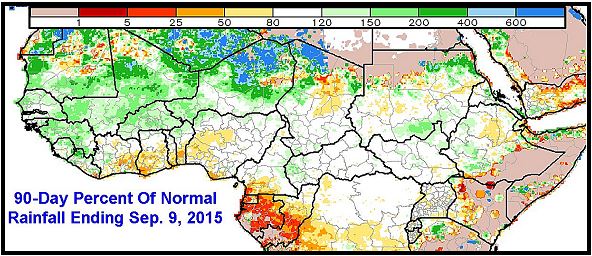
Much of the same region from western Nigeria into central and southern Ghana has experienced below average precipitation since the middle of June. Rain totals for the 90-day period ending September 9 were 50-80% of normal across the region and into southeastern Ivory Coast.
The persistence of below average rainfall in these areas is not unusual for significant El Nino years. However, it has had a negative impact on coffee, cocoa, sugarcane and rice production with cocoa probably suffering most significantly, thus far. The second part of the annual rainy season is due now and if it fails to develop the dryness could have a much larger impact on all four commodities.
The lack of rain in August is not usual for most years since the ITCZ is normally too far north to bring much rain into coffee, cocoa and sugarcane areas, but that usually only lasts for a few weeks. This year’s dryness evolved in late July and has yet to end and the next two weeks look to be notably drier biased again. The below-average rainfall in Ghana and western Nigeria was already significant earlier in the year and the delayed resumption in rainfall now is a bigger event because crops did not have a good moisture reserve in the subsoil to fall back upon during the drier period. Now rain is needed more than ever and the longer it is delayed the more stressed crops will become and the higher their potential production cuts might become.
Seasonal rainfall in southern portions of west-central Africa normally evolves in late September and October. The rain is normally enough to bolster soil moisture and promote a good environment for cocoa, coffee, rice, sugarcane and other crops. As long as the rain evolves soon, the stressful conditions will be relieved and some recovery from the dryness will be possible. However, the environment has been drier than usual for a long enough period of time that some production will not be recovered and that is one of the driving forces behind rising commodity prices.
West-central Africa is just one area of many being impacted by rainfall reductions because of El Nino. Another one of the larger regions suffering from dryness is Indonesia where a large amount of coffee, cocoa and sugarcane is also produced. Crops in Indonesia are also being stressed by the lack of rain and warmer than usual conditions.
Scattered shower and thunderstorm activity will evolve in west-central Africa during the next two weeks. Much of the resulting rainfall will be welcome and it will bring some short term relief to the drier bias. However, larger volumes of rain will be needed to turn crop conditions around. World Weather, Inc. anticipates below average rainfall will continue over an extended period of time lasting well into October and that may continue to pressure coffee, cocoa, rice and sugarcane production downward.
World Weather, Inc. forecasts and comments pertaining to present, past and future weather conditions included in this report constitute the corporation’s judgment as of the date of this report and are subject to change without notice. Comments regarding damage or the impact of weather on agricultural and energy as well as comments made regarding the impact of weather on the commodity and financial markets are the explicit opinions of World Weather, Inc. World Weather, Inc. can not be held responsible for decisions made by users of the Corporation’s information in any business, trade or investment decision.
©2015 World Weather, Inc. Any unauthorized redistribution, duplication or disclosure is prohibited by law and will result in prosecution.