

Snow Cover Needed In Ukraine, Other Parts of CIS
By Andrew Owen and Drew Lerner
Kansas City, November 18 (World Weather Inc.) – Ukraine and neighboring areas in southern Russia and far western Russia, as well as the Baltic States and Belarus are too cold to support winter wheat and rye development. No significant warming is expected in the near future and most crops are expected to remain dormant. Snow is needed to shield crops from the potentially damaging properties of bitter cold air, although no bitter cold is expected for a while. In the meantime, recent weather has brought needed moisture to some of the previously driest  areas of Ukraine and Southern Russia raising the potential for crop improvements early next spring.
The most recent snow cover map suggests that much of Russia has adequate snow on the ground to protect winter crops from any potentially threatening weather that comes along in the next few weeks. However, snow free conditions are still common in Russia’s Southern Region as well as in areas from the Baltic States and extreme western Russia through Belarus to most of Ukraine. Northern portions of Kazakhstan also had snow on the ground while portions western and southern Kazakhstan was snow free.
The lack of snow is not of much concern until bitter cold temperatures come around. Bitter cold would be a serious threat to poorly established wheat and rye crops in Ukraine, southern Russia and Kazakhstan. Some of the winter crops in those areas were planted in dry soil resulting in poor emergence and establishment. Crops that are not well established will always run a risk of suffering from winterkill conditions in the event that temperatures extremes occur without adequate snow cover. Snow acts as an insulating blanket for dormant winter crops and can help prevent crop death during the winter when temperatures become bitterly cold.
There is no risk of bitter cold in the snow free areas anytime soon, but producers are looking for snow cover now that crops are dormant or semi-dormant as a little added insurance that no further crop damage will occur.
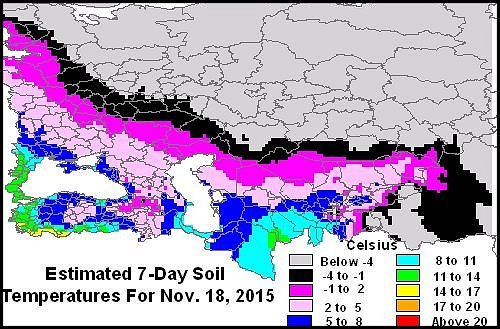 Most soil temperatures are low enough now that winter grains are dormant. The only exception remains near the Black Sea where temperatures might still be warm enough for a little root and tiller development. Most areas away from the coast are too cold to support any new crop growth until spring.
In the meantime, precipitation has finally evolved in the western CIS’s driest areas. A succession of weather disturbances moving through Ukraine and parts of southern Russia have bolstered soil moisture in those areas where the ground has not become frozen.
Much of the western CIS reported significant precipitation during the seven-day period ending November 16. Moisture totals ranged from 0.50 to 1.57 inches from far southwestern Russia, Belarus and northern and easternmost Ukraine into Krasnodar and a part of Russia’s Southern Region. Portions of the middle Volga River Basin and southern Ural Mountain region into far northwestern Kazakhstan also received more than 1.00 inch of moisture. Moisture totals elsewhere were much lighter varying up to 0.50 inch  and much of that moisture occurred in the form of snow.
Winter wheat and rye did not establish well in Ukraine, parts of Russia’s Southern Region or western portions of Kazakhstan this autumn. Some planting in Ukraine was never completed and many crops were seeded in dry or nearly dry soil resulting in poor emergence and establishment. The region dealt with dryness for much of the summer and autumn. Wheat and rye production will be cut this year because of these conditions, but recent precipitation will be of use to surviving crops in the spring and some general improvement to crop condition may evolve. Nearly 14% of the Ukraine crop was not planted this year because soil temperatures go too cold while farmers waited for significant moisture.
Other sections of the western CIS received enough precipitation over the autumn to promote good planting and establishment conditions. Production in these wetter areas will likely be normal as long as timely precipitation and warm weather evolve in the spring.
Several disturbances will advance across the western CIS during the next seven days. Most areas from the Baltic States through the Ural Mountains region will be cold enough for snow. Areas from Ukraine through western Kazakhstan will see precipitation alternate between rain and snow. Precipitation amounts will be enough to slightly increase soil moisture in the driest areas of the western CIS.
The snow that does accumulate from Ukraine through western Kazakhstan will not be enough to completely blanket the ground and it may melt away rather quickly. Cooler weather will shift into the southwestern CIS at the beginning of next week, which will help some of the snow remain on the ground for more than a day. Most other sections of the western CIS will have enough snow accumulate by the beginning of next week to shield winter crops from any potentially damaging cold weather that might come along in the next few weeks.
World Weather, Inc. forecasts and comments pertaining to present, past and future weather conditions included in this report constitute the corporation’s judgment as of the date of this report and are subject to change without notice. Comments regarding damage or the impact of weather on agricultural and energy as well as comments made regarding the impact of weather on the commodity and financial markets are the explicit opinions of World Weather, Inc. World Weather, Inc. can not be held responsible for decisions made by users of the Corporation’s information in any business, trade or investment decision.
©2015 World Weather, Inc. Any unauthorized redistribution, duplication or disclosure is prohibited by law and will result in prosecution.