

Dryness Has Brazil Soybean Planting Behind Schedule
By Andrew Owen and Drew Lerner
Kansas City, November 9 (World Weather Inc.) – Aggressive planting progress occurred in Brazil soybean production areas during the past week after some beneficial rainfall occurred early this month. Fieldwork is behind the usual pace because of notable bouts of heat and dryness. Some improved conditions this month have brought on a better environment for fieldwork, but planting still has a way to go and this coming week’s weather will remain rather dry slowing emergence and establishment in portions of the production region. Some excessive moisture in October may have delayed fieldwork in some southern Brazil crop areas, but progress has moved along better than expected under the circumstances in those wetter areas.
 Mato Grosso and Goias reported timely rain during the past week that helped bolster soil moisture. Rain totals for the seven day period ending this morning ranged from 0.50 to 2.85 inches most often. Other areas from southern Minas Gerais and Rio de Janeiro through much of center-south and southern Brazil reported 1.00 to 3.50 inches of rain with locally greater amounts in Rio de Janeiro and northern Parana. The northern half of Minas Gerais and southern Bahia were again mostly dry.
Topsoil moisture is rated excessive in a large part of southern Brazil from southern Minas Gerais to Rio Grande do Sul, parts of Paraguay and southern and western Mato Grosso do Sul. Even though the ground is saturated, recent rain has come and gone in spurts and that has kept flood potentials low. Any persistent heavy rain that evolves in the next few weeks before the ground gets a chance to dry out might lead to some notable flooding, but the short term forecast is not offering that kind of heavy or excessive rainfall.
Soil moisture in Mato Grosso and Goias varies greatly. Some areas have adequate soil moisture while others have a slight shortage of moisture. The northern half of Minas Gerais, Bahia, and immediate neighboring areas are driest in Brazil. Soil moisture is critically short in most locations and it is time for seasonal rainfall to begin.
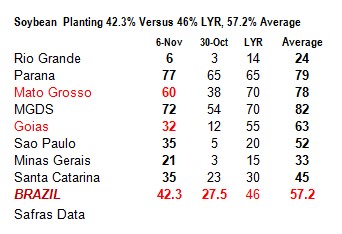
Soybean planting progress as of November 6 was 42.3% complete across Brazil, compared to 57.2% average. Mato Grosso had 60% of the crop in the ground compared to the average of 79% while Goias had 32% of the crop planted compared to 63% for the average. Most other soybean production areas are also behind normal planting dates. Rice, corn and cotton planting have advanced differently, but planting progress has been made with some crops going into the ground quicker than usual and others slower than usual. Rice planting as of Nov. 6 was 44% complete in Rio Grande do Sul which is suspected of being behind average due to rain delays that were rather persistent in October. Cotton planting is likely most advanced.
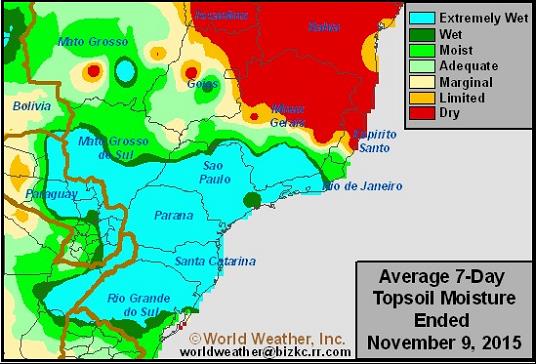
Another detriment resulting from the wet conditions in southern Brazil has been delayed winter wheat harvesting. It is unclear how much wheat is left to be harvested, but most of it should be in Rio Grande do Sul where weather conditions were better for harvesting over a short period of time in late October and early November. The quality of this year’s wheat was downgraded last month, but improved weather up until recently had stopped the decline. Dry weather is needed to firm up the topsoil and promote a better environment for all crops in southern Brazil whether they are developing spring crops or mature winter crops waiting to be harvested.
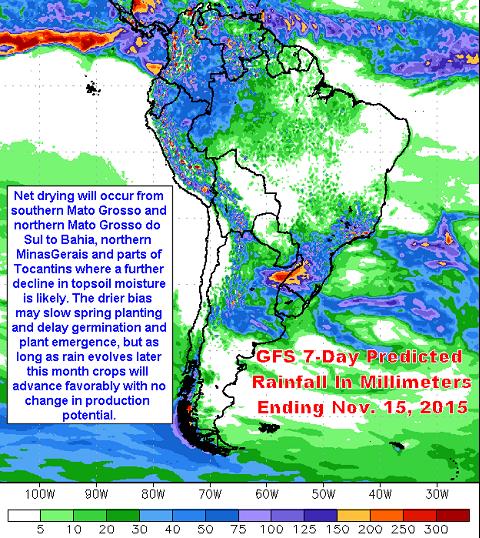
Weather this week will produce frequent rain in southern Brazil from Rio Grande do Sul to southern Minas Gerais. Showers and thunderstorms to the north will be quite infrequent and light resulting in a new drying environment. The drier bias may delay farming activity, but more likely it will just delay seed germination and plant emergence in areas that are already a little dry.
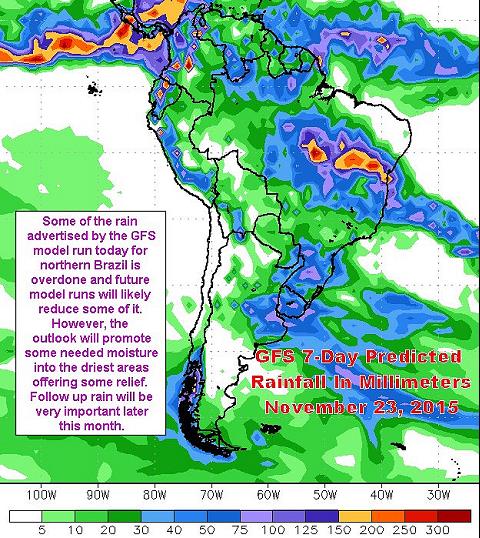
Next week’s weather promises some relief to the dry biased areas in northern Brazil. The precipitation may not be as great as advertised by some of the forecast models, but it will evolve to the benefit of recently planted summer crops. Drying in southern Brazil will come and go and the improvement from saturated field conditions will be a little slow to evolve.
Temperatures will trend near to above average across Brazil this week. The temperature profile has often been warmer than normal in recent weeks, which increased drying rates. The lack of rain and warm weather in northern Brazil helped promote the poor planting conditions. Daytime highs in center-south and northern Brazil will often be in the upper 80s and 90s Fahrenheit with warmer pockets. Southern Brazil will warm into the upper 70s and 80s most often with warmer pockets. Drying rates will be high between rain events. Some extreme highs will rise above 100 degrees Fahrenheit daily in northeastern Brazil until rain evolves this weekend.
World Weather, Inc. forecasts and comments pertaining to present, past and future weather conditions included in this report constitute the corporation’s judgment as of the date of this report and are subject to change without notice. Comments regarding damage or the impact of weather on agricultural and energy as well as comments made regarding the impact of weather on the commodity and financial markets are the explicit opinions of World Weather, Inc. World Weather, Inc. can not be held responsible for decisions made by users of the Corporation’s information in any business, trade or investment decision.
©2015 World Weather, Inc. Any unauthorized redistribution, duplication or disclosure is prohibited by law and will result in prosecution.